Back to Program Verification Index | Previous: (y-05) SMT-LIB | Next: (y-07) Relational Semantics
Mental Model for Boogie and Boostan
- Why a new language? Real languages (C, Java) are too messy to verify directly. We translate them into a “clean” intermediate language like Boogie.
- Boogie is a verification-oriented language. It has things programmers want (types, procedures) but is designed to be easily turned into logic formulas.
- Boostan is a tiny, formal fragment of Boogie that we use in class to define perfect mathematical rules for how code works.
- Boogaloo is a tool that lets us “run” Boogie code even when it’s non-deterministic, helping us find bugs early.
Why not verify C or Python directly?
- Syntax Bloat: These languages have hundreds of features that are hard to formalize.
- Vague Semantics: The rules for C are often defined in hundreds of pages of English text, which can be ambiguous.
- Intermediate Power: By translating many languages (C, Java, C#) into one intermediate language (Boogie), we only have to build one verifier.
The Verification Pipeline
Modern verifiers follow a specific translation chain:
- Source Code (e.g., C, Java): Messy, complex, and hardware-specific.
- Intermediate Language (e.g., Boogie): Clean, mathematical, and focused on assertions/assumptions.
- SMT Solver (e.g., Z3): Receives the logic formulas and checks if an assertion violation is “satisfiable” (meaning a bug exists).
Boogie: The Verification Language
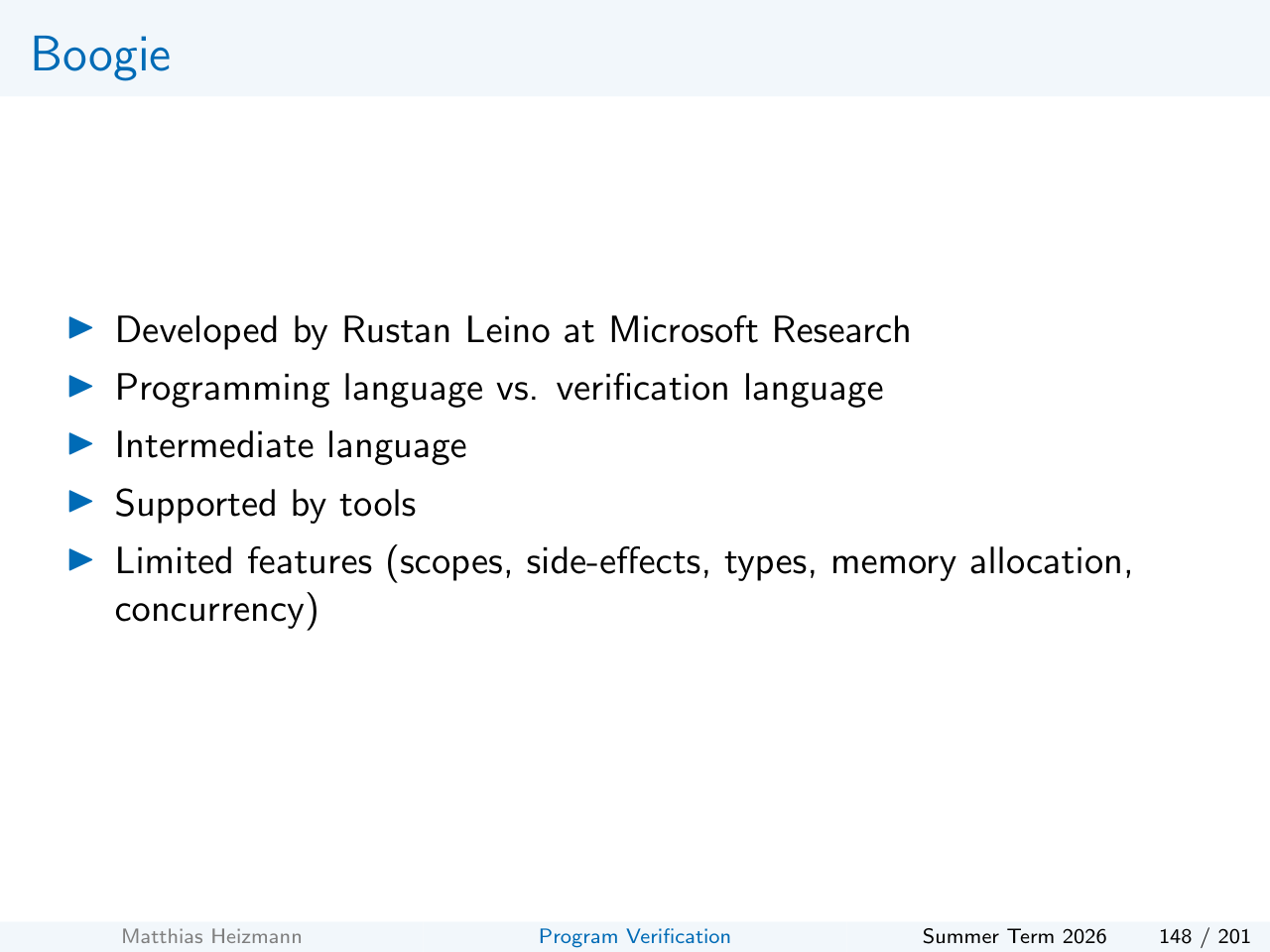
Developed by Rustan Leino at Microsoft Research, Boogie is used by tools like Ultimate Automizer and Dafny.
Key Features of Boogie
- Procedures: Named blocks of code with inputs and outputs.
requires P: A precondition that must hold before calling the procedure.ensures Q: A postcondition that the procedure promises to satisfy upon termination.- Assignments:
x := x + 1. - Assumptions:
assume x > 0. If this is false, the execution “stops” or is ignored. - Assertions:
assert x > 0. This is a promise that must hold true.
Example Boogie Code
procedure Square(a: int) returns (square: int)
    requires a >= 0;    // Precondition
    ensures square >= a; // Postcondition
{
    square := a * a;
    if (square == 0) {
        assume {:print "a is zero"} true;
    } else {
        assume {:print "a = ", a} true;
    }
}
Tool: Boogaloo
Boogaloo is an interpreter and symbolic executor for Boogie. It allows you to explore the state space of your Boogie code before running a full proof tool.
Command Line Options
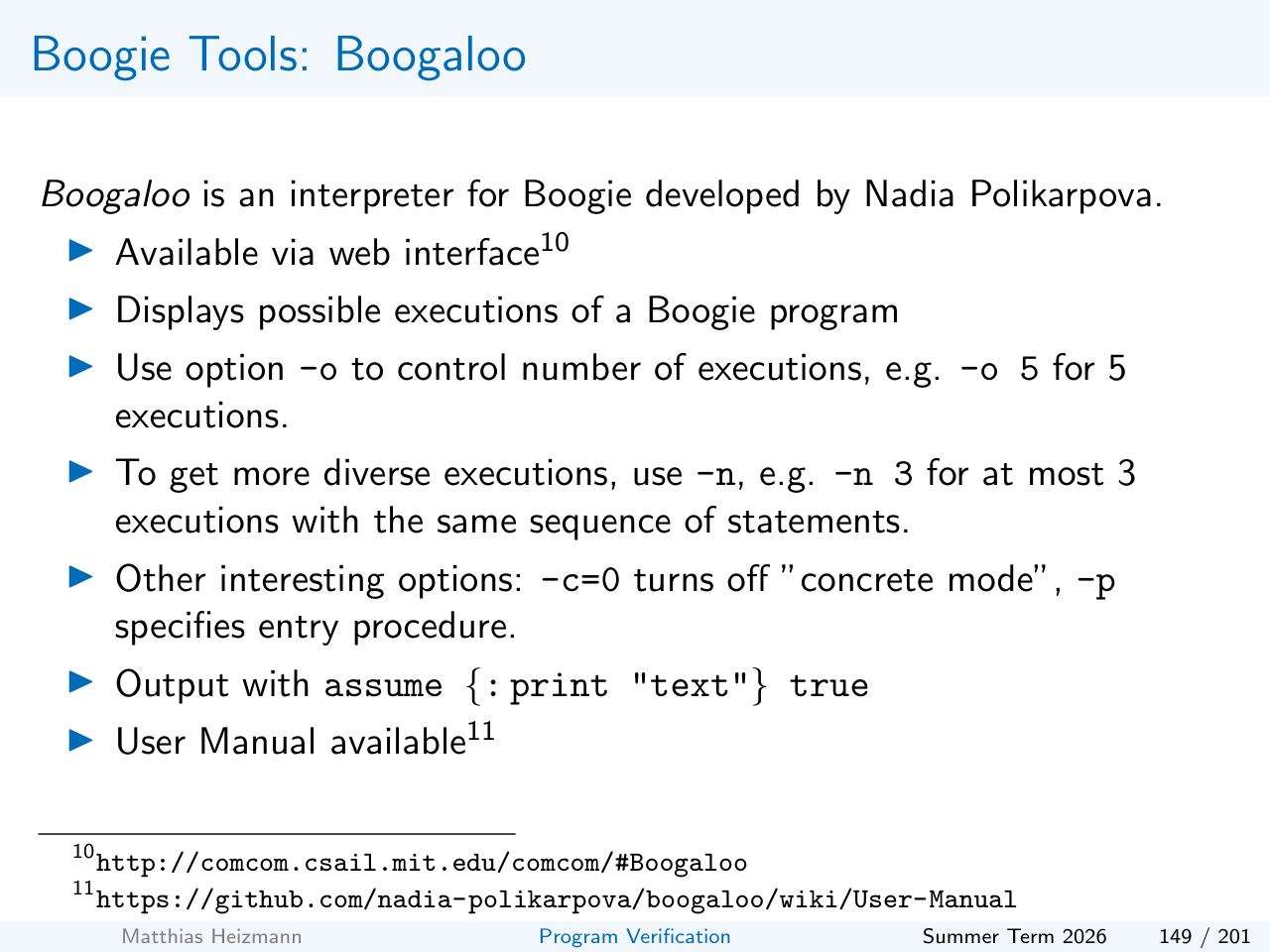
-o [n]: Control the total number of executions to explore.-n [n]: Limit the number of executions per unique sequence of statements (prevents getting stuck in infinite loops).-c=0: Turns off “concrete mode” (allows variables to take symbolic values instead of just simple constants).-p [proc]: Specifies the entry procedure to begin execution.
💡 Intuition: Asserts vs. Assumes
…
assume P: The verifier can take it for granted that P is true. It is a filter that tells the verifier, “Only look at cases where P holds.” If P is false, the path is ignored.
Boostan: The Formal Fragment
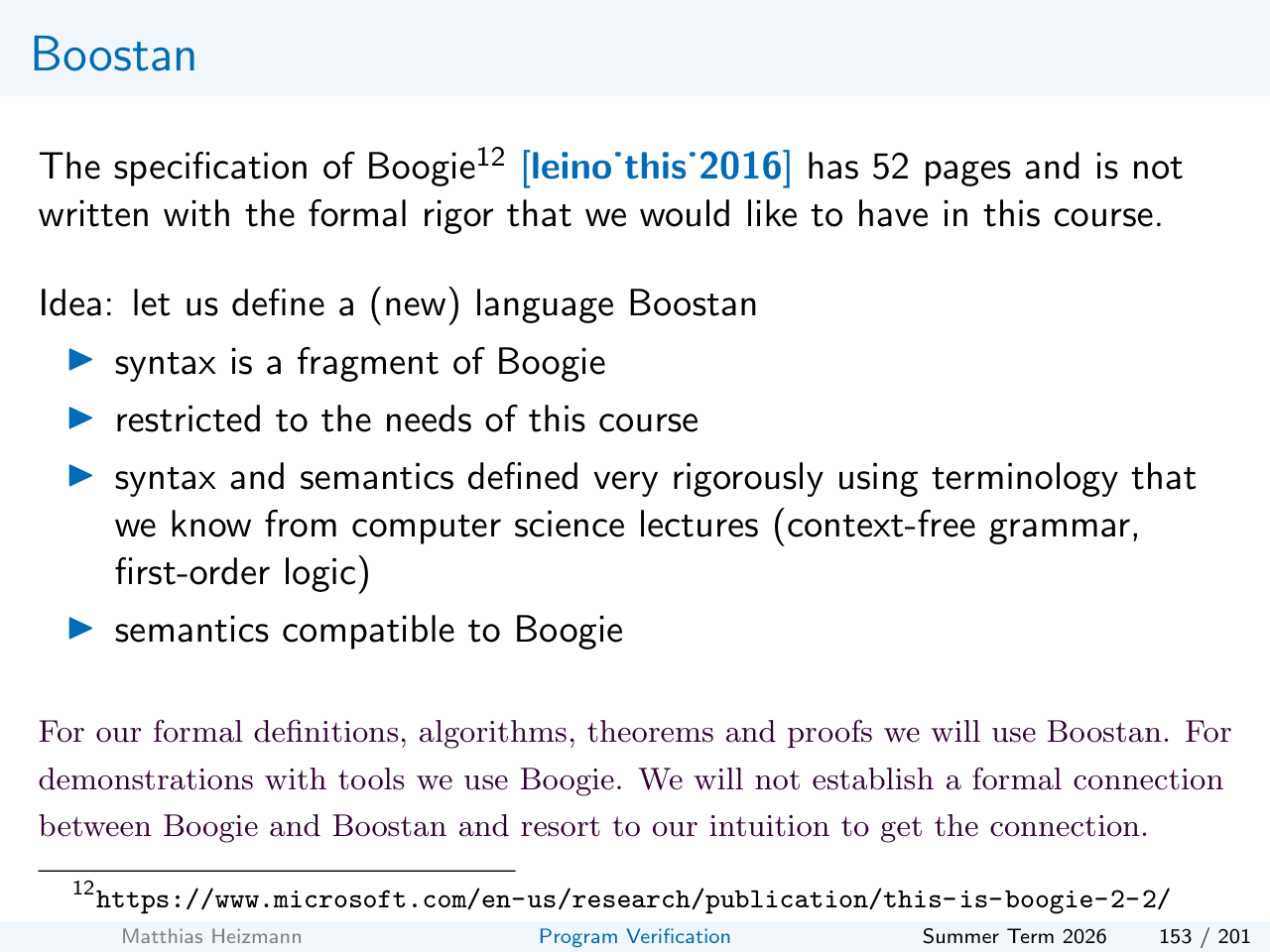
Boostan is a simplified version of Boogie used for defining formal relational semantics.
🧠 Deep Dive: The Formal Grammar
A Boostan program is a sequence of commands :
- Skip:
skip(Does nothing) - Assignment:
x := e(Update variable with expression ) - Sequence: (Execute , then )
- If-Then-Else:
if (b) { c_1 } else { c_2 } - While Loop:
while (b) { c } - Havoc:
havoc x(Assign a non-deterministic value to ) - Assume:
assume b(Filter execution paths) - Assert:
assert b(Verify a condition)
💡 The “Small Vocabulary” Approach
Why do we limit Boostan to only a few commands?
- Ease of Formalization: It’s much easier to write mathematical rules for 8 commands than for 800.
- Completeness: These few commands are actually Turing-complete! Any complex program (with
forloops,switchstatements, etc.) can be rewritten using just these basic building blocks. - Orthogonality: Each command does exactly one thing, making the semantics “clean” and predictable.
Summary
- Intermediate Languages like Boogie simplify verification by providing clean semantics.
- Boogie is the industry standard for intermediate verification; Boostan is our teaching version.
- Procedures in Boogie allow us to modularize proofs.
- Assumes filter states, while Asserts check for bugs.
- Boogaloo helps us debug our Boogie programs before we run a full verifier.
Self-Check
- Why do verifiers translate C, Java, or C# into Boogie instead of working on the source directly?
Answer
Real languages have hundreds of features and ambiguous English-text semantics, which makes them hard to formalize. Boogie is a clean, mathematically defined intermediate language with a small core, so multiple front-ends can target it and a single verifier handles all of them. The translation isolates verification from the messy parts of each source language.
- What is the operational difference between
assume Pandassert Pin Boogie?
Answer
assume Pfilters executions: paths wherePis false are dropped from consideration, so the verifier proceeds as ifPwere given.assert Pis a proof obligation: the verifier must showPholds along every path that reaches it; if any path falsifiesP, the verifier reports a bug. Assumes constrain inputs; asserts check outputs.
- List the commands of Boostan () and explain why such a small set is enough.
Answer
Boostan has
skip,x := e, sequencing ,if (b) {c_1} else {c_2},while (b) {c},havoc x,assume b, andassert b. These commands are Turing-complete: any richer construct (for,switch,return) can be desugared into them. The small core makes the formal semantics tractable while keeping enough expressive power.
- What is
havoc x, and why does verification need it?
Answer
havoc xassigns a non-deterministic value tox. It is used to model unknown inputs, the effect of an under-specified call, or to “forget” a variable’s value at the top of a loop so the verifier reasons about an arbitrary iteration. It is the basic source of non-determinism in Boostan.
- What does Boogaloo do and how does it complement a full verifier?
Answer
Boogaloo is an interpreter and symbolic executor for Boogie. With flags like
-o,-n,-c=0, and-p, it explores executions of a procedure, including non-deterministic ones, before you invoke a heavy proof tool. This lets you catch obvious bugs and sanity-check the model cheaply; once Boogaloo is happy, you run the verifier for a real correctness proof.
Back to Program Verification Index | Previous: (y-05) SMT-LIB | Next: (y-07) Relational Semantics | (y) Return to Notes | (y) Return to Home